


What can I do to reduce contamination? #
There are several things you can do to reduce contamination:
- Construct green buildings.
- Buy policies.
- Water the tree when it is not leafy.
- Demolish business or residential buildings, which are the most polluting.
What happens if my contamination indicator reaches the maximum? #
If the current contamination exceeds the meter’s threshold, several things can happen, depending on the segment in which it is positioned:
- Maroon segment:
- Population growth is frozen.
- You cannot level up the city.
- The business buildings stop producing Keplers.
- Black segment: the construction and improvement of buildings is prohibited, except for the construction of green buildings.
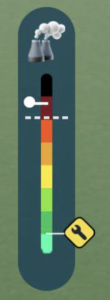
Why do I have two indicators on the contamination meter? #
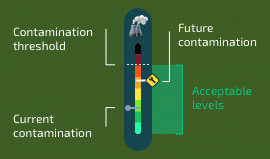
There are two indicators:
- Current contamination indicator: indicates the pollution in your city at that moment. It’s represented by a white bar with a circle.
- Future contamination indicator: indicates what the level will be once all the buildings currently under construction are completed.
This indicator should help you make decisions about which buildings to build and when to build them.
Before buying a building, you can find out how its construction will affect contamination by checking its corresponding information card. The color of the arrow on the contamination meter will indicate what the future contamination will be.
These indicators exist to warn you of pollution in your city, which, if the threshold (marked by a dotted line) is exceeded, can have negative effects.
How can I see the impact a building, an improvement, or a policy has on contamination? #
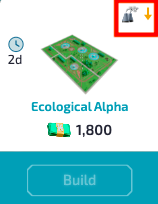
You’ll find the buildings of each category in the “Build” menu. Each of these is represented on a card. At the top right, you’ll see the contamination symbol and a colored arrow. The color of the arrow represents at what level future contamination will be after the building is constructed. The position of the arrow represents the increase or decrease of contamination: the up arrow means that future contamination will go up; the down arrow means that future contamination will go down.
For example, if you build a green building, the arrow will point downwards and will be the same color as where the indicator of future contamination will be located once the building is bought.